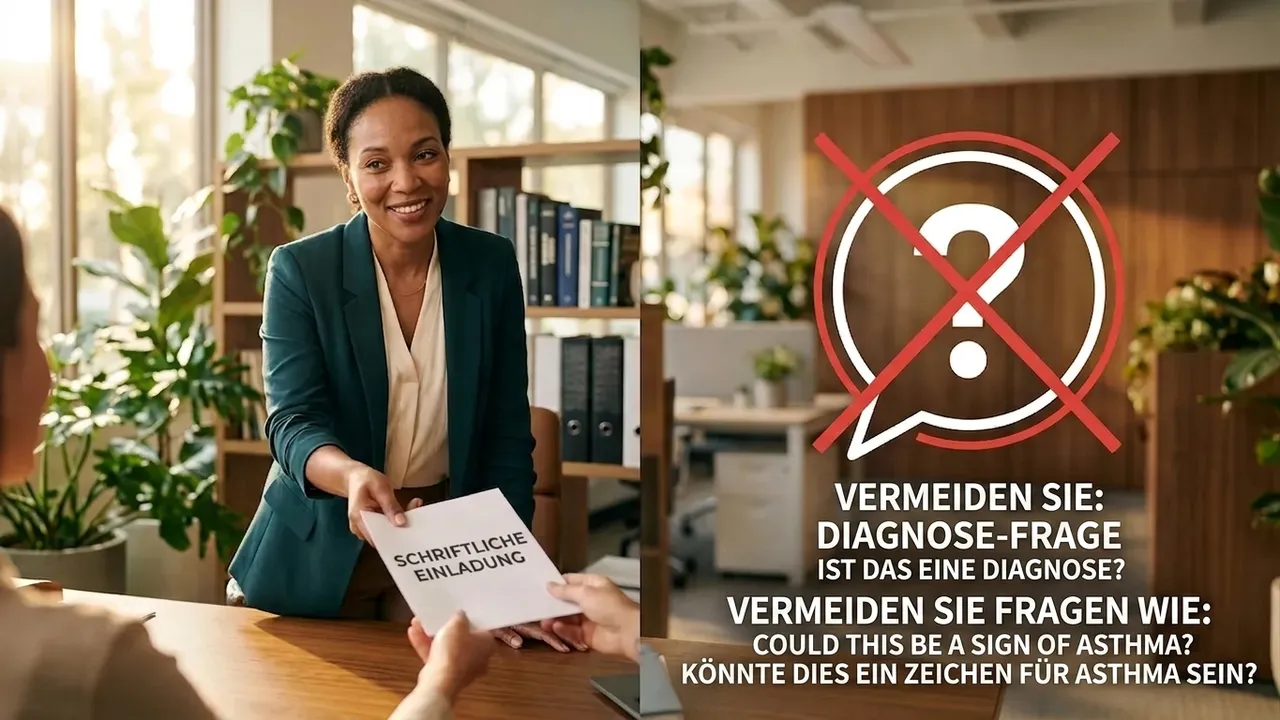
BEM Dos and Don'ts
BEM Dos and Don'ts: What Are the Most Common Employer Mistakes in Return-to-Work Management?
The most common BEM mistakes: verbal instead of written invitations, diagnosis questions, BEM records in the personnel file, undocumented refusals, and unmonitored measures. Each mistake makes a later illness-related dismissal legally vulnerable.
BEM Dos and Don'ts at a Glance
| Do | Don't | Why |
|---|---|---|
| Send a written invitation and document delivery | Invite verbally, in a hallway conversation, or vaguely ('a talk about your absences') | Without a verifiable, formally complete offer, the BEM is deemed never to have been offered (Federal Labor Court, 7 AZR 698/14) |
| Explicitly emphasize that participation is voluntary | Apply pressure or imply consequences for non-participation | BEM is voluntary for employees (§167(2) SGB IX) — pressure makes the entire process legally vulnerable |
| Discuss how the illness affects work and possible workplace adjustments | Ask about the diagnosis or the cause of the illness | Diagnoses are health data (Art. 9 DSGVO) — the employee is not required to disclose them |
| Keep the BEM file separate and limit access to a minimal group | File BEM records and conversation notes in the personnel file | Incorrect filing is a data protection violation (Art. 9 DSGVO) and creates an evidentiary problem in unfair dismissal proceedings |
| Document the refusal and offer BEM again when a new trigger occurs | Treat a refusal as permanently 'closed' | The obligation to offer BEM arises anew each time an employee exceeds 42 absence days within a new rolling 12-month window |
| Agree on concrete measures with deadlines and track them | End the meeting without a written outcome record | Without a record, the BEM cannot be proven in court — it is treated as if it never took place |
Mistakes in the Invitation Phase
Note: This overview reflects requirements under German law — SGB IX, the DSGVO, and rulings of the Federal Labor Court (BAG). Employers outside Germany should verify equivalent obligations with local counsel. The first and most consequential mistake happens before any conversation takes place: a formally defective invitation. The Federal Labor Court (7 AZR 698/14) requires a written invitation that explains the purpose of BEM (preserving the job, overcoming incapacity to work), points out that participation is voluntary, and explains the data protection implications (what data is collected, who has access). A verbal invitation or a vaguely worded 'talk about your absences' that never mentions BEM by name is formally considered incomplete — legally, the BEM is then deemed never to have been offered at all.
Second invitation mistake: the offer comes too late, or not at all. The obligation arises as soon as an employee exceeds 42 cumulative working days of absence within a rolling 12-month window (§167(2) SGB IX) — immediately, not at the end of the quarter. Employers who only review absence data monthly or quarterly routinely miss the trigger date and end up facing a later dismissal without ever having made a BEM offer.
Third mistake: pressuring language. Phrases like 'we expect you to participate' or an unreasonably short response deadline ('meeting tomorrow at 9 a.m.') undermine the voluntary nature of BEM and make the invitation legally contestable. In practice, a 14-day response period has become the established standard.
Fourth mistake: delivery cannot be proven. An email without a read receipt or a personal hand-off without a witness is of no help in a dispute. A registered letter with proof of delivery has proven effective in practice — that proof becomes the first document in the BEM file.
Mistakes During the Conversation
The classic mistake in the conversation itself is asking about the diagnosis. Diagnoses are a special category of health data (Art. 9 DSGVO) — employees are not obligated to disclose them, and employers should not ask. The BEM conversation should focus on how the illness affects work and on possible workplace adjustments (workstation, working hours, tasks) — not on the illness itself. Anyone who presses for a diagnosis anyway destroys trust and risks a data protection violation.
Second mistake: conducting the BEM as an interrogation or as groundwork for a dismissal. The conversation must have an open outcome — labor courts will not recognize a BEM that is clearly designed only to shore up a dismissal decision that has already been made. Practical consequence: the conversation should not be led by a supervisor who has already voiced intentions to dismiss the employee.
Third mistake: overlooking the right to bring a support person. Employees may bring a trusted colleague or a works council member; at the employee's request, the works council must be involved (§167(2) SGB IX). If this right is not mentioned in the invitation or is blocked during the meeting, the process becomes formally vulnerable to challenge.
Fourth mistake: the conversation ends without a result. A BEM conversation where people simply 'talked' but no concrete measures with deadlines and responsibilities were agreed on and recorded fails the statutory clarification purpose — and cannot later be proven to have been a proper BEM.
Mistakes in Documentation and Follow-Up
The costliest documentation mistake: BEM records end up in the personnel file. The BEM file, containing meeting records and health-related information, must be kept separate from the personnel file, with access limited to a minimal group. Only proof that the process took place belongs in the personnel file: that a BEM was offered, when, and whether it was accepted or declined — no substantive content.
Second mistake: the refusal is not documented. It is legitimate for an employee to decline — but without a record (date of the invitation, method of delivery, date and manner of the refusal), the BEM is treated in court as though it was never offered. It is equally wrong to treat a refusal as permanently 'closed': as soon as the employee again reaches 42 absence days within a new 12-month window, a new invitation must be issued.
Third mistake: agreed measures are not followed up. An action plan without a review of its effectiveness is worthless — both for the employee and as evidence. A review after four to six weeks, with an updated record and a follow-up conversation if needed, has proven effective in practice.
The consequence of all these mistakes shows up in unfair dismissal proceedings: under Federal Labor Court ruling 7 AZR 698/14, an illness-related dismissal without a properly conducted BEM is regularly disproportionate. A BEM that was carried out but not documented is treated exactly the same as one that never happened — the employer bears the burden of proof, and without a file, that burden is practically impossible to meet.
Related measures & topics
Key takeaways
- Always invite in writing, stating the purpose, the voluntary nature of participation, and data protection information — otherwise the BEM is deemed never to have been offered
- Never ask about the diagnosis — the conversation is about working conditions, not the illness itself (Art. 9 DSGVO)
- Keep the BEM file strictly separate from the personnel file — only the offer, its date, and acceptance/refusal belong in the personnel file
- Document refusals and make a new offer whenever the 42-day trigger recurs — a refusal is never permanently 'closed'
- Close every conversation with a written outcome record and follow up on measures — an undocumented BEM does not count in court
Frequently asked questions
What is the most common BEM mistake employers make?+
Missing or formally defective documentation — from the invitation, through the employee's response, to the outcome record. Even a well-conducted conversation is treated in court as no BEM at all if it lacks a documented framework. The consequence: a later illness-related dismissal is regularly disproportionate (BAG 7 AZR 698/14).
May the employer ask about the diagnosis during the BEM conversation?+
No. Employees are not required to disclose their diagnosis — diagnoses are health data under Art. 9 DSGVO. The BEM conversation should focus on how the illness affects work and on possible workplace adjustments. Pressing diagnosis questions destroy trust and jeopardize the legal soundness of the process.
Is a BEM valid without a written invitation?+
No. The Federal Labor Court (7 AZR 698/14) requires a written invitation explaining the purpose, the voluntary nature of participation, and data protection. A verbal invitation or an informal return-to-work conversation does not meet these requirements — the BEM is then considered improperly initiated, with all the consequences that has for a later dismissal.
Must an employer ever issue a new invitation after a BEM refusal?+
Yes. A refusal applies only to that particular trigger event. As soon as the employee again reaches 42 cumulative absence days within a new 12-month window, the obligation to offer BEM under §167(2) SGB IX arises again — regardless of how many times it was declined before. Each new invitation and each new refusal is documented separately.
What happens if mistakes were made in the BEM and the employee is later dismissed?+
Formal errors (an incomplete invitation, a missing record, an undocumented refusal) cause the BEM to be considered improperly conducted. In unfair dismissal proceedings, the employer then bears an increased burden of proof: they must show that even a correctly conducted BEM could not have prevented the dismissal — in practice this is almost impossible to prove, so the dismissal is regularly held invalid.
Systematically Rule Out BEM Mistakes
EasyBGM automatically detects the 42-day threshold, generates formally complete invitations from a template, and logs every BEM step in a traceable way — kept separate from the personnel file.
Sources
- §167(2) SGB IX — Workplace Reintegration Management (BEM) ↗
- Federal Labor Court ruling 7 AZR 698/14 (May 19, 2016) — Requirements for the BEM Invitation and Consequences of a Missing BEM ↗
- Federal Labor Court ruling of Feb. 7, 2012 — 6 AZR 78/11 (BEM Documentation and Filing) ↗
- Art. 9 DSGVO — Processing of Special Categories of Personal Data (Health Data) ↗
- KSchG §1 — Social Justification for Dismissal ↗
Last updated: 2026-07-07. This guide refers to German law (§ 167 SGB IX) and is not legal advice — have your specific case reviewed by a professional.