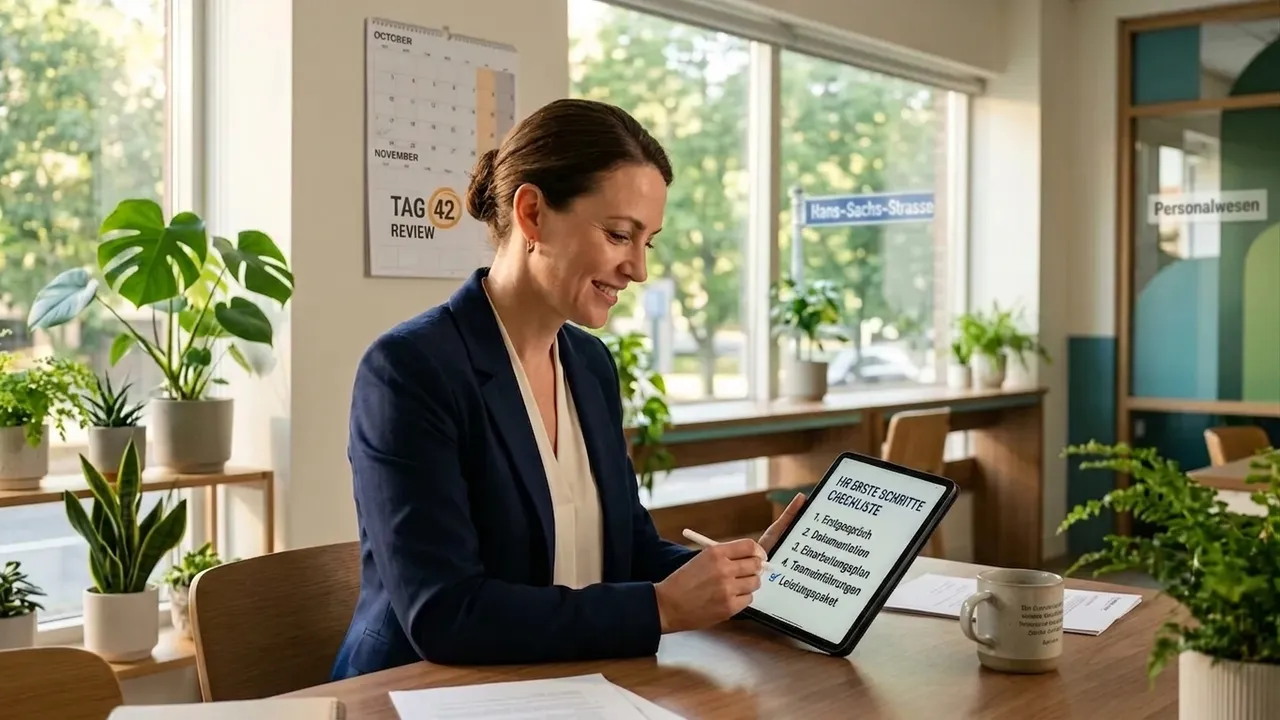
First BEM Case: Immediate Help
First BEM case at your company: What exactly do you need to do now?
Check absences (42 working days within 12 months, §167 Para. 2 SGB IX), send a written invitation with all mandatory elements, hold an open-ended conversation, agree measures in writing, document every step. Documentation decides everything in a dispute.
The first 5 steps in your first BEM case
| Step | What to do specifically | Most common mistake |
|---|---|---|
| 1. Recognize the trigger | Add up all illness-related absences from the last 12 months: from 42 cumulative working days (6 weeks), the employer is required to offer BEM (§167 Para. 2 SGB IX) | Counting only long single illnesses — wrong: all absences are added together, including many short ones |
| 2. Send a written invitation | Send the invitation stating the legal basis, purpose (support, not oversight), voluntary participation, a data protection notice, the right to bring a companion, and a contact person | A verbal or vague invitation ('a conversation about your absences') that never uses the word BEM |
| 3. Prepare and hold the conversation | Schedule the meeting with sufficient lead time, in a neutral setting, and discuss working conditions and strain with an open outcome | Asking about the diagnosis, or treating the meeting like a disciplinary conversation about absences |
| 4. Agree on measures | Record concrete steps in writing: workplace adjustments, phased return to work, transfer — with deadlines and responsible parties | Vague statements of intent without a deadline or assigned responsibility |
| 5. Document and follow up | File the invitation, the employee's response, the meeting minutes, the measures, and the effectiveness review in a separate BEM file | Filing in the general personnel file — or no documentation at all |
Steps 1 and 2: Recognizing the Trigger and Sending a Legally Compliant Invitation
Note: this guide describes obligations under German law — Workplace Integration Management (Betriebliches Eingliederungsmanagement, BEM) under §167 SGB IX of the German Social Code (SGB IX). It does not reflect US employment law and is not legal advice; requirements outside Germany differ significantly.
The first BEM case almost always starts with uncertainty: is this already a BEM case? §167 Para. 2 SGB IX provides the answer: as soon as an employee has been unable to work for a total of more than six weeks — that is, 42 cumulative working days — within the preceding 12 months, the employer must offer BEM. Working days are counted, not calendar days, and all absences are added together regardless of whether one or several illnesses are behind them. The 12-month window rolls continuously.
The obligation applies to every employer — regardless of industry or company size. And it rests with the employer, not the employee: an employer who waits for the employee to initiate a conversation is violating the duty to initiate BEM. In a first case, this means concretely: add up the absences of the last 12 months, check the threshold, and act once it is exceeded — not just at the end of the quarter.
The second step is the written invitation. Germany's Federal Labor Court (BAG, case 7 AZR 698/14) has set out concrete requirements: the invitation must explain the purpose of BEM (overcoming the incapacity to work, preserving the job), point out that participation is voluntary and that declining carries no consequences, describe the procedure, explain how data will be handled, and name a contact person. The right to involve a person of trust or the employee representation body must also be included.
A common mistake in a first case: the invitation vaguely describes the process as 'a conversation about your absences' — without using the word BEM. Such an invitation is formally considered incomplete. Equally off-limits are phrasings that create pressure ('we expect you to participate'): BEM is a support offer, not a control mechanism. Delivery should be verifiable, and the employee needs enough time to respond — in practice, 14 days has become the standard.
Steps 3 and 4: Holding the Conversation and Agreeing on Measures
If the employee accepts the invitation, the BEM conversation follows. It is not an interrogation or a disciplinary talk about absences, but an open-ended clarification process: which workplace factors make the return more difficult? What adjustments are possible? The employee decides who takes part — the works council or the representative body for employees with severe disabilities is only involved with the employee's consent, and the employee may additionally bring a person of trust of their own choosing (§167 Para. 2 SGB IX). Questions about the diagnosis are off-limits; the focus is working conditions, not medical details.
Important for a first case: the conversation should not be led by someone who has already voiced thoughts of dismissal — doing so undermines the credibility of the support offer and makes the whole process vulnerable to challenge. In smaller companies without their own HR department, management or a designated BEM contact person typically leads the conversation.
Step 4 follows from the conversation: agreeing on concrete measures in writing. Typical outcomes are workplace adjustments, changed working hours, a transfer, or a phased return to work (the 'Hamburg Model'). If participation benefits come into consideration, §167 Para. 2 SGB IX provides for involving the rehabilitation providers or — for employees with a severe disability — the integration office. Every measure needs a deadline and a responsible person.
A BEM process can also end without a result — that is permissible, provided it was conducted and documented with an open outcome. What is not permissible is a pro forma BEM that is clearly meant only to shore up a dismissal that has already been decided. Labor courts do not recognize such proceedings.
Step 5: Documentation — and Why This Step Decides Everything
The fifth step determines the outcome of all the previous ones in a dispute: documentation. In settled case law (BAG 2 AZR 716/06, reaffirmed by 7 AZR 698/14), Germany's Federal Labor Court has made clear that a dismissal for health reasons is generally disproportionate if no BEM was conducted or offered beforehand. And in court, only what can be proven counts: a BEM that took place but was not documented is treated as if it never happened.
The BEM file should contain: the invitation letter with proof of delivery, the employee's response (acceptance or refusal, with date), the meeting minutes with participants, the measures discussed, and the outcome, as well as the follow-up on the agreed measures. If the employee declines, the obligation ends for that particular trigger — but it is precisely then that documenting the refusal is the only proof that the employer met its obligation.
The BEM file is kept separately from the personnel file: BEM records contain health data (Art. 9 GDPR) and may only be accessible to a tightly limited group of people — not the direct supervisor, not payroll. Speculation about the causes of illness or diagnoses has no place in the minutes; the process is documented, not the health condition.
Follow-up means two things: first, checking the effect of the agreed measures (in practice after around 4–6 weeks, with a follow-up conversation if needed), and second, continuing to monitor absences. Because the BEM obligation is not a one-time event: if the employee again reaches the 42-day threshold within a new 12-month window, a new invitation must be issued — regardless of how the first case turned out.
Related measures & topics
Key takeaways
- 42 cumulative working days of absence within 12 months = obligation to offer BEM — for every employer, regardless of company size
- The invitation must be in writing and state the purpose, voluntary nature, data protection, the right to bring a companion, and a contact person
- The conversation must be open-ended and free of diagnosis questions — the employee determines who takes part
- Agree on measures in writing with a deadline and a responsible person — vague statements of intent don't hold up
- Without documentation, the BEM is treated as never having taken place — and a dismissal for health reasons is generally invalid (BAG 7 AZR 698/14)
Frequently asked questions
How quickly must action be taken after reaching the 42 days?+
The obligation arises as soon as the threshold is exceeded — not just at the end of the month or quarter. §167 Para. 2 SGB IX does not set a statutory deadline for the invitation, but the longer the employer waits, the harder it becomes to later demonstrate that the duty to initiate BEM was taken seriously. In practice: send the written invitation promptly once the trigger is recognized.
Who conducts the BEM process in a small company without an HR department?+
The obligation applies to the employer regardless of company size — §167 Para. 2 SGB IX has no size threshold. Without HR, management or a designated BEM contact person handles the initiation and leads the conversation. What matters is separating roles: whoever has already communicated intentions to dismiss should not lead the conversation.
What happens if the employee declines the BEM invitation?+
Declining is permitted — BEM is voluntary for employees. The employer's obligations end for that particular trigger, but the refusal must be documented without gaps: date of the invitation, method of delivery, date and form of the refusal. Without this documentation, a court will treat the BEM as never having been offered.
Does the works council have to be involved in the first BEM case?+
Only with the employee's consent — the employee decides whether the employee representation body takes part in the process (§167 Para. 2 SGB IX). Companies with a works council should, as a general rule, still govern the BEM process in a works agreement (procedure, data protection, participants); the works council also monitors whether the employer fulfills its BEM obligations.
Can an employee be dismissed while a BEM process is ongoing?+
BEM is not a formal precondition for a dismissal to be valid, but without a properly conducted BEM, a dismissal for health reasons is, under BAG case law (7 AZR 698/14), generally considered disproportionate. Courts do not recognize a BEM that is only carried out after the decision to dismiss has already been made, 'for cover' — the clarification purpose is then defeated.
First BEM Case? Deadlines, Invitations, and Records in One System
EasyBGM automatically detects the 42-day threshold, generates BEM invitation letters from templates with all mandatory elements, and documents every step in a traceable way.
Sources
- §167 Para. 2 SGB IX — Workplace Integration Management (BEM) ↗
- BAG ruling 7 AZR 698/14 (May 19, 2016) — Requirements for BEM invitations and protection against dismissal ↗
- BAG ruling 2 AZR 716/06 — Landmark ruling on the BEM obligation ↗
- BMAS — Practical Guide to BEM ↗
- BAuA — Guide to BEM for Employers ↗
Last updated: 2026-07-07. This guide refers to German law (§ 167 SGB IX) and is not legal advice — have your specific case reviewed by a professional.